Shower Door Handle Hole Centres: What B2B Buyers Should Confirm Before Ordering
AoTi Hardware · Hardware selection notes ·
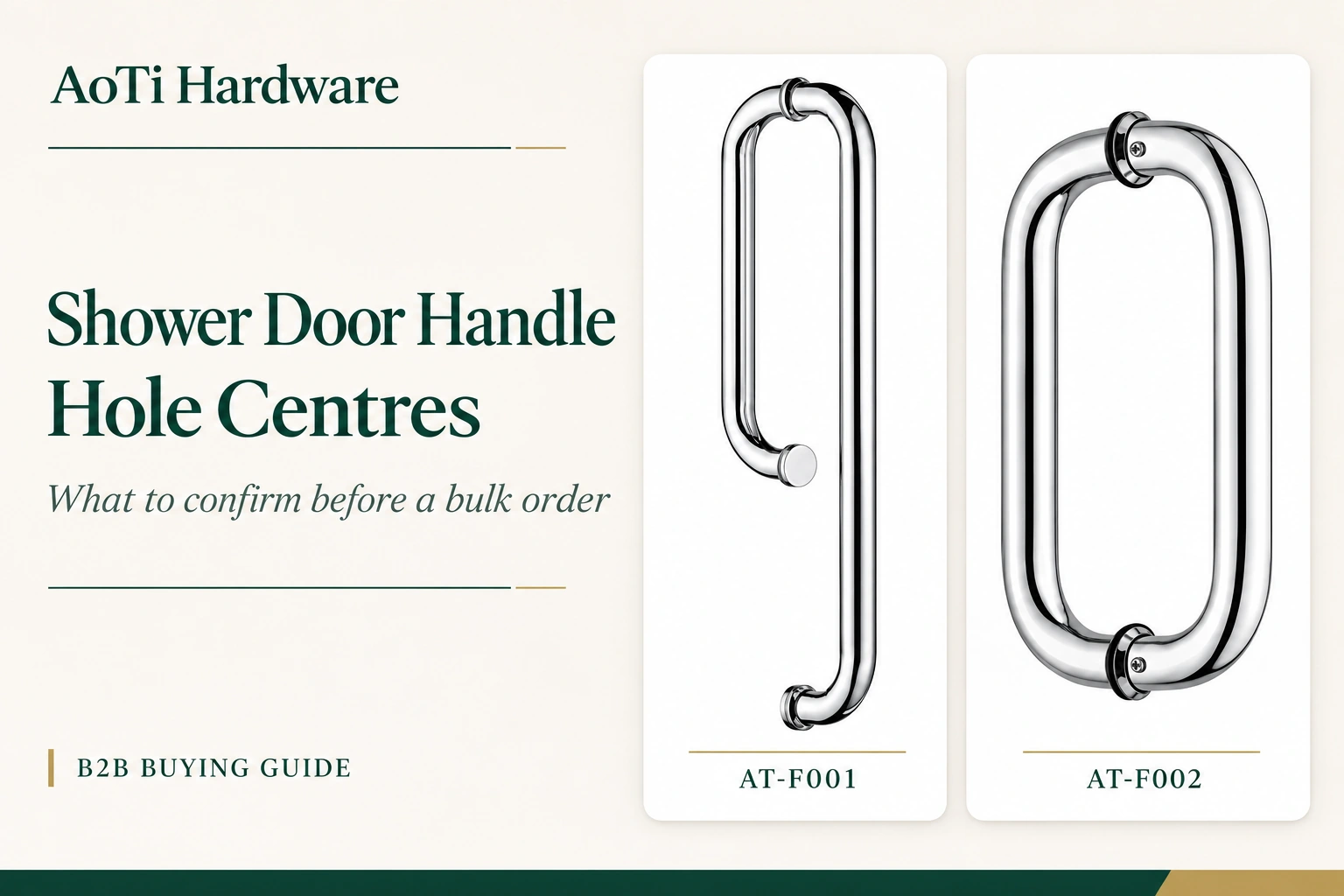
A shower door handle can look right in a catalogue and still be unsuitable for the glass prepared for your project. For enclosure manufacturers, distributors and project purchasing teams, the drawing is as important as the appearance.
Before ordering a sample or approving a production batch, separate the handle's overall dimensions from its fixing geometry. Then confirm the glass preparation, supplied fixing parts and selected material version in writing. This guide explains how to turn a visual shortlist into a clearer purchasing specification.
1. Do not confuse overall length with fixing centres
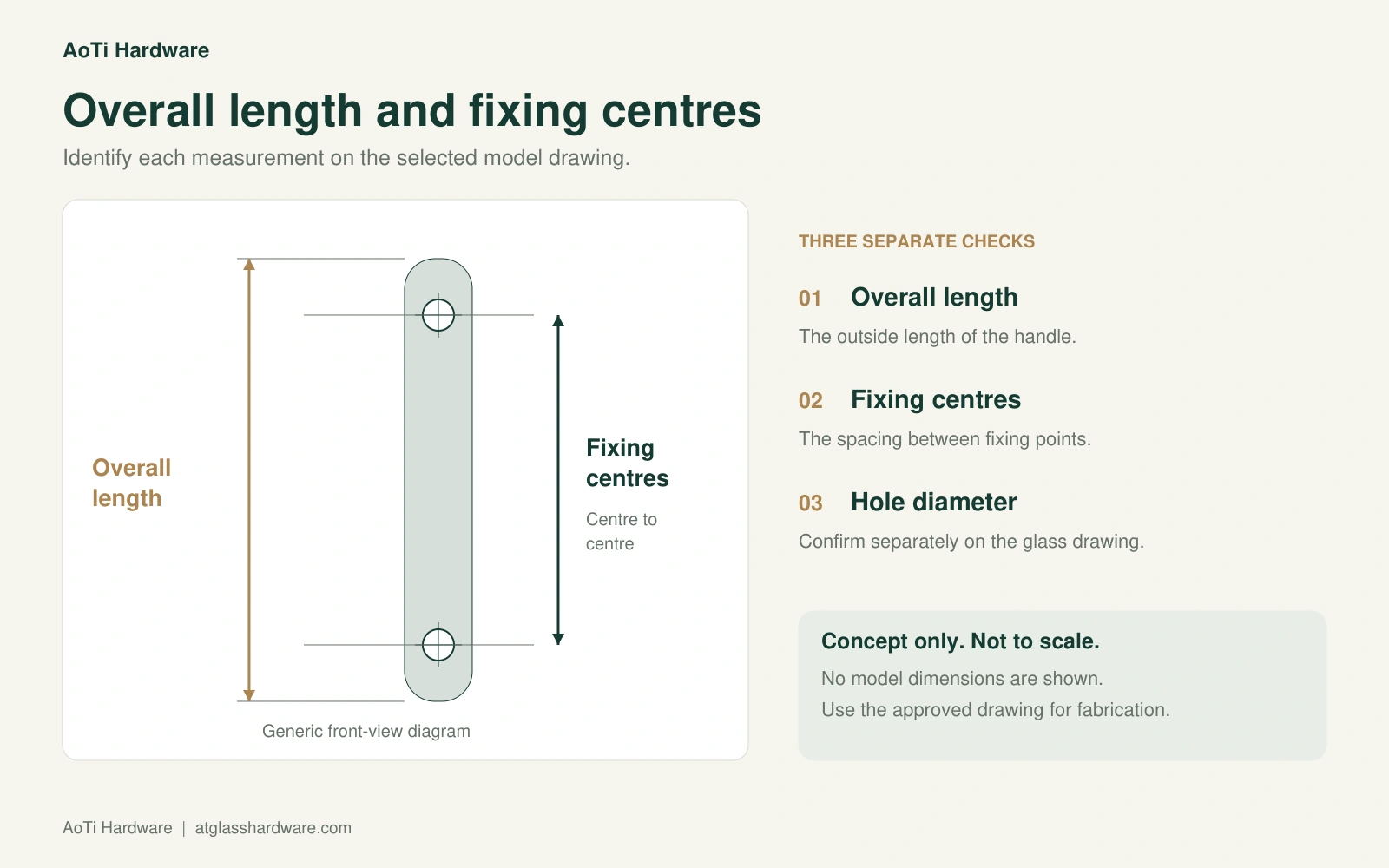
Overall length describes the outside length of the handle. Fixing centres describe the distance between the centres of its fixing points. Those measurements serve different purposes and should be identified separately on the drawing.
An overall length alone does not tell the glass fabricator where the holes belong. A photograph also does not establish the spacing accurately enough for an order. Ask for a dimensioned drawing of the exact model and version being quoted.
For a two-point pull handle, the review should identify:
- Overall length and handle profile.
- Centre-to-centre distance between the fixing points.
- Required glass hole diameter and any additional preparation.
- Handle projection and the space needed on each side of the glass.
- The fixing assembly and the glass thickness range confirmed for that assembly.
For a single-point knob, review its fixing arrangement separately. A dimension intended for a two-point pull should not be copied into a knob specification.
2. Distinguish new glass from replacement work
For a new enclosure
Select the handle before approving the glass preparation. Give the fabricator the final supplier drawing, the selected hardware version and the enclosure layout. Have the responsible project team approve the preparation before glass manufacturing proceeds.
The handle also needs to work with the whole enclosure. Review its position against the door edge, nearby wall, fixed panel and other fittings. Check the usable grip area and movement clearance in the actual layout, rather than judging the handle in isolation.
For an existing door
Start with the existing preparation. Record the actual hole spacing, hole size, glass thickness and available clearance. Provide photographs of both sides and the old fixing parts where available, together with a measured sketch.
Two handles with a similar silhouette may use different fixing assemblies. Ask the supplier to review the measurements before treating a new model as a replacement. A visual resemblance is a starting point for discussion, not a compatibility approval.
3. Specify the complete fixing package
Agree what one saleable unit contains. Depending on the selected design, a quotation may describe one handle, a pair for both sides, or another assembly. The order should make that distinction explicit.
Ask the supplier to identify the bolts, washers, sleeves, gaskets and other parts included with the selected version. Request an assembly drawing or parts photograph when the contents are unclear. Do not substitute a locally available fixing simply because it appears to fit; obtain confirmation for the proposed assembly.
For distributors, a labelled parts list also makes later service requests easier to describe. Keep the model reference and approved drawing revision with the batch record so that replacement discussions refer to the same specification.
4. Confirm the material grade and finish separately
Material and finish are different order fields. A broad description such as stainless steel does not, by itself, identify a particular grade. Likewise, a finish name does not establish a coating process, corrosion test result or suitability for every environment.
For example, the public AT-F001 handle page lists stainless steel and bright or sanding finishes. Buyers requiring a particular stainless steel grade should request confirmation for the selected version before making that grade part of a purchase specification.
If a handle must coordinate with hinges, clamps and a support bar, compare approved physical samples under agreed viewing conditions. Record which parts and finishes the approval covers. Do not assume that the same colour name across different components guarantees an identical appearance.
5. Send an RFQ that the supplier can answer
A useful request for quotation gives the supplier enough information to identify the product, review the application and state any unresolved points. Include:
| RFQ field | What to provide or request |
|---|---|
| Product reference | Exact model, reference image and required configuration |
| Application | New enclosure or replacement; relevant door layout |
| Glass preparation | Approved dimensions or measured existing preparation |
| Material | Required grade, or a request to confirm the available grade |
| Finish | Finish reference and whether a physical sample is required |
| Supplied unit | Single item, pair or complete assembly, with parts list |
| Order plan | Quantity by model and finish, destination and required delivery window |
| Documentation | Drawing revision, packing details and any project-specific evidence requested |
Keep unknown fields visible. A clearly marked question is more useful than an assumed dimension that later becomes part of the order.
6. Make sample approval specific
Review the sample against the proposed drawing and parts list. Record any differences before approving production. If a detail changes during sampling, update the order documents and confirm which revision governs the batch.
The approval record can cover dimensions, the fixing package, finish appearance, packaging and identification. Any performance or compliance requirement should be agreed separately with evidence relevant to the exact model and configuration; an appearance approval does not establish those results.
Frequently asked questions
Is handle length the same as hole spacing?
No. Overall length and fixing centres describe different measurements. Ask for both on the selected model drawing.
Can I buy a replacement from a photograph alone?
A photograph helps identify the design, but it does not confirm compatibility. Send measured glass preparation, thickness, clearance and fixing details for review.
Does a stainless steel description mean SUS304?
No specific grade should be assumed from that description alone. Request written confirmation for the version being ordered.
What should I approve before a bulk order?
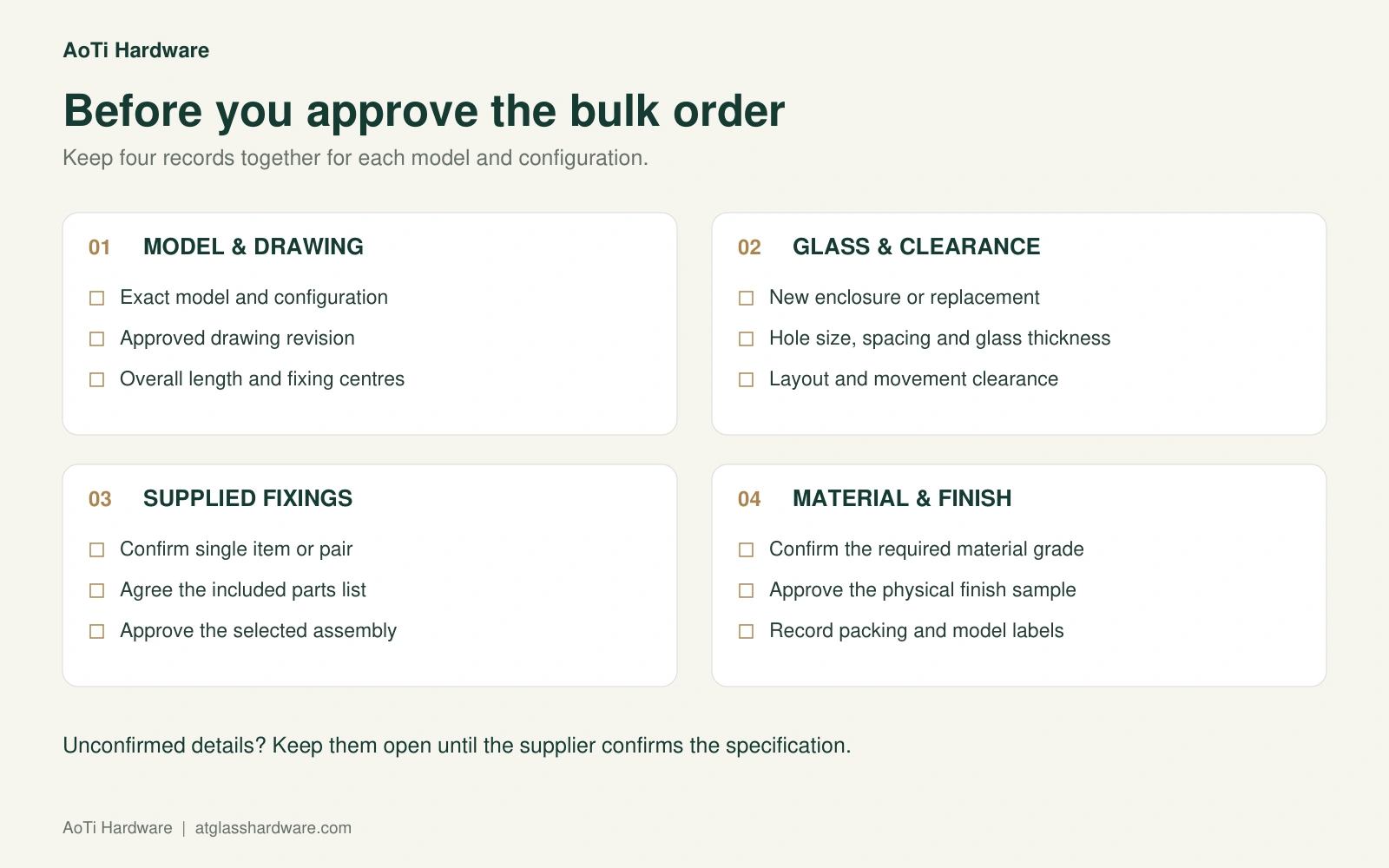
Approve the model and configuration, drawing revision, glass preparation, fixing contents, material requirement, finish sample and packing specification. Keep unresolved requirements open until they have been confirmed.
Discuss your handle specification with AoTi Hardware
Explore the AoTi Hardware handles and knobs collection and review AT-F001 or AT-F002 as starting points for your shortlist. Model dimensions, available material versions and application suitability require confirmation before order approval.
For the wider enclosure, read our shower door hinge procurement checklist.
Contact AoTi Hardware with your model list, quantities, glass details and destination market. Ask us to confirm the selected drawing and supply scope before you release the order.