Shower Glass Clamps: What UK Trade Buyers Should Specify Before Ordering
AoTi Hardware · Hardware selection notes ·
A shower glass clamp may look like a straightforward component. For a glass processor, however, it raises questions about glass preparation. For an enclosure manufacturer, it must fit the approved assembly. For a hardware importer, the same specification needs to remain clear when the next order arrives.
When buying shower glass clamps for UK trade supply, start with the installation layout and the exact model specification. Finish and unit price become useful comparisons once the connection, glass requirements and supplied parts are defined.
This guide sets out a practical enquiry and sample-approval checklist for fixed shower panel clamps. Final component selection and installation should follow the approved drawings and the responsible project team's requirements.
1. Identify the connection and the clamp's role
Mark the proposed clamp positions on the enclosure drawing. Show which panels are fixed, which door opens, and whether each connection is glass-to-wall, glass-to-glass or another arrangement.
A fixed-panel clamp and a moving-door hinge perform different jobs. Also confirm whether the layout calls for channels, support bars or other components; do not assume that choosing a clamp resolves the complete panel-support arrangement.
Use the glass clamps collection to make an initial shortlist, then request the drawing for each proposed model. Where the enclosure includes an opening door, review the shower door hinges separately.
2. Give the glass processor a defined drawing reference
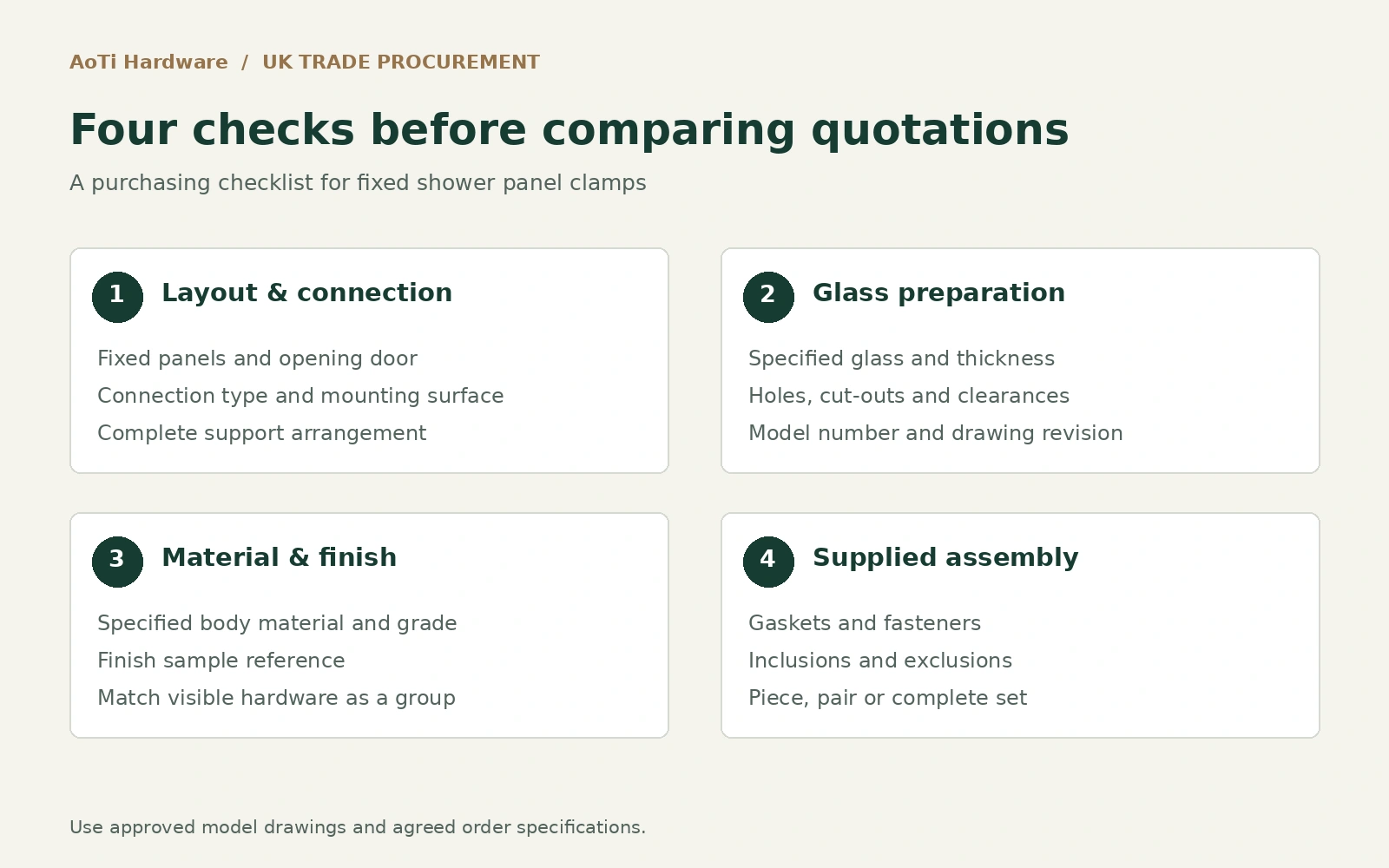
Before releasing glass for manufacture, obtain the selected clamp's glass preparation details and confirm them with the glass processor.
The review should cover:
- The specified glass type and thickness.
- Any required holes, notches or cut-outs.
- Hole and cut-out positions relative to glass edges.
- Required clearances and the mating components.
- The model number, drawing revision and approval status.
Do not transfer a hole pattern from an existing clamp to a new one based on appearance. A similar body shape does not establish dimensional compatibility. Equally, treat a claim such as “no drill” as a model-specific feature that requires confirmation.
For repeat enclosure production, reference the approved hardware drawing in the production records so that purchasing and glass processing use the same version.
3. Confirm the mounting surface and complete fixing arrangement
Show the supplier the actual mounting condition, including any frame, curved profile, wall return or finished surface.
The shape of a clamp base is one selection detail; it does not establish suitability for every surface. Likewise, a visible tiled finish does not define the substrate behind it or the appropriate anchoring arrangement.
Ask what the quotation includes and what must be specified or sourced separately. The responsible project team should review the mounting arrangement as part of the installation design.
If the layout includes additional bracing, review the proposed shower support bars and their connection details alongside the clamps.
4. Separate material specification from decorative finish
Record the body material and its specified grade separately from the surface finish. A description such as “stainless steel” alone does not identify a particular grade. A colour name alone does not define the underlying material or finishing process.
For a useful quotation comparison, request the same material specification, finish and component package from each supplier. Agree what supporting material or finish documentation is required for the order.
Where clamps, hinges, handles and support bars are visible together, review physical samples as a group. Approving each item from a separate catalogue photograph can leave appearance differences unresolved until assembly.
5. Define the gaskets, screws and packing contents
A purchase order should identify the complete supplied assembly, rather than only the metal clamp body.
Confirm the gasket set for the specified glass thickness, the supplied fasteners, any covers or small fittings, and any installation items excluded from the package. Request a parts list or a photograph of the complete supply set.
For importers, agree the individual pack contents, carton quantity and model labels. For enclosure manufacturers, confirm whether components arrive individually packed or grouped for assembly. State whether the quotation is per piece, pair or complete set.
These details make quotations easier to compare and give goods-in staff a clear inspection reference.
6. Build a repeatable bulk-order specification
Use the following fields when preparing a request for quotation.
| RFQ field | Information to provide or confirm |
|---|---|
| Application | Fixed shower panel layout and intended connection |
| Selected model | Supplier model reference and drawing revision |
| Glass | Type, thickness, panel dimensions and preparation drawing |
| Mounting | Contact surface, substrate information and fixing arrangement |
| Material and finish | Specified material grade, surface finish and sample reference |
| Supplied assembly | Gaskets, fasteners, covers, inclusions and exclusions |
| Quantity | Quantity per model and finish; piece, pair or set basis |
| Packing | Individual pack contents, labels and carton quantities |
| Inspection | Agreed dimensional, appearance and assembly checks |
| Delivery | UK destination, required schedule and quotation delivery terms |
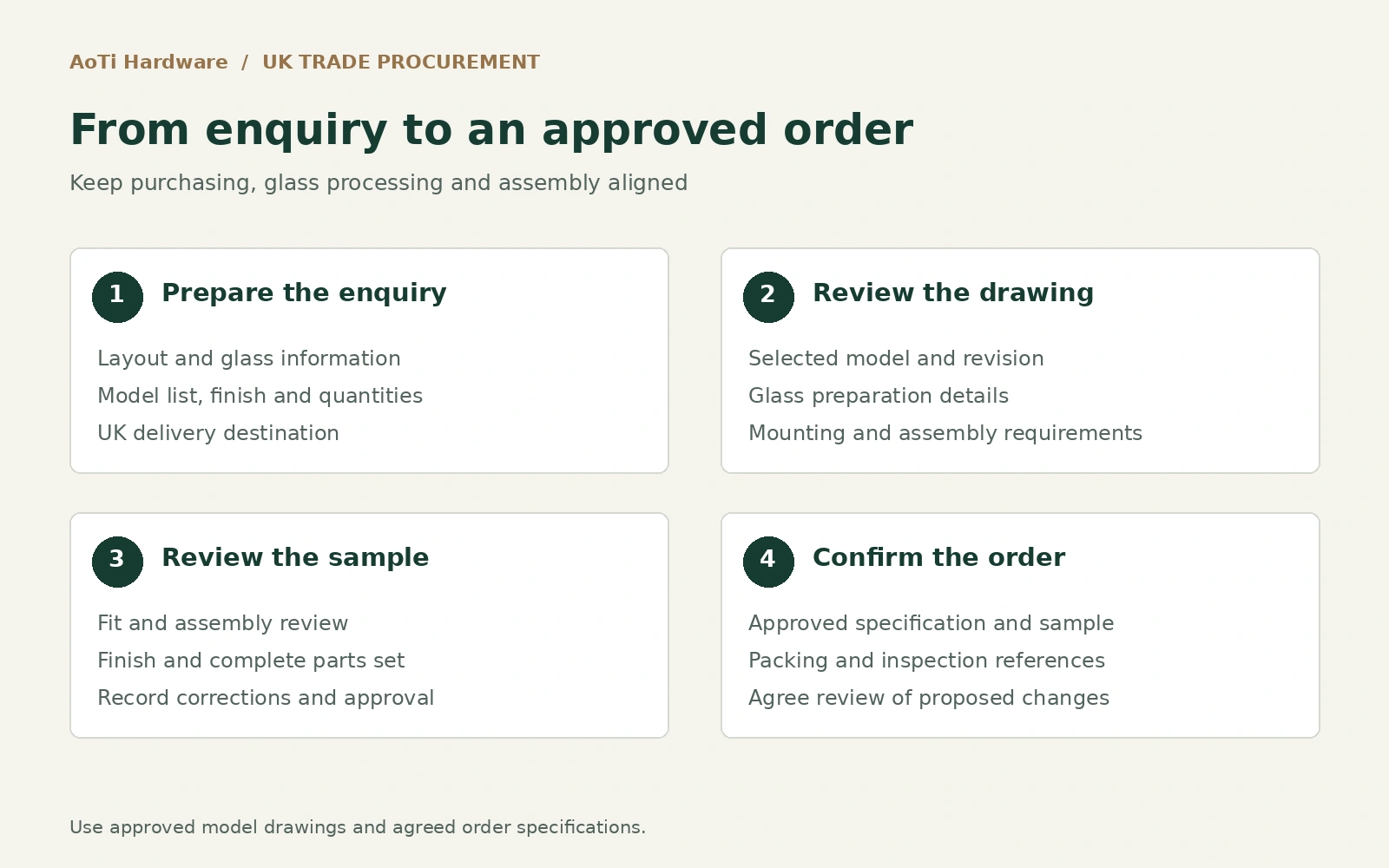
Keep a reference sample and its approval record. Agree how proposed changes to dimensions, materials, finishes or supplied parts will be reviewed before a later production batch.
7. Approve the sample before confirming the bulk order
Review the sample against the proposed production specification. Check the model identity, documented dimensions, finish, gasket set, fastener contents and packing.
Have the relevant glass processor or enclosure team review the proposed fit and assembly using the approved drawings. Record any corrections before placing the bulk order.
A sample review helps confirm what will be supplied. It does not replace any project-specific design review or required performance evidence.
Frequently asked questions
Can shower glass clamps replace U-channel?
That depends on the selected hardware and the complete enclosure design. Confirm the panel-support arrangement and fixing details before changing from a channel-based layout to clamps.
Are clamps with the same glass thickness interchangeable?
Glass thickness is only one compatibility field. Compare glass preparation, mounting geometry, clearances, gaskets and the approved connection details before considering a replacement.
What should a UK trade buyer send for a quotation?
Send the enclosure layout, proposed model references, glass information, finish, quantity and delivery destination. Include any required inspection records or supporting documents so these can be addressed in the quotation.
Discuss your shower glass clamp requirements
Preparing a model list for UK distribution or enclosure production? Contact AoTi Hardware with your layout, glass information, required finish and quantities. We can review the proposed selection with you and identify the specification details that need confirmation before quotation and sample approval.